Protecting Sensitive Data in AI Workflows: Key Security Risks
 Sajid Saiyed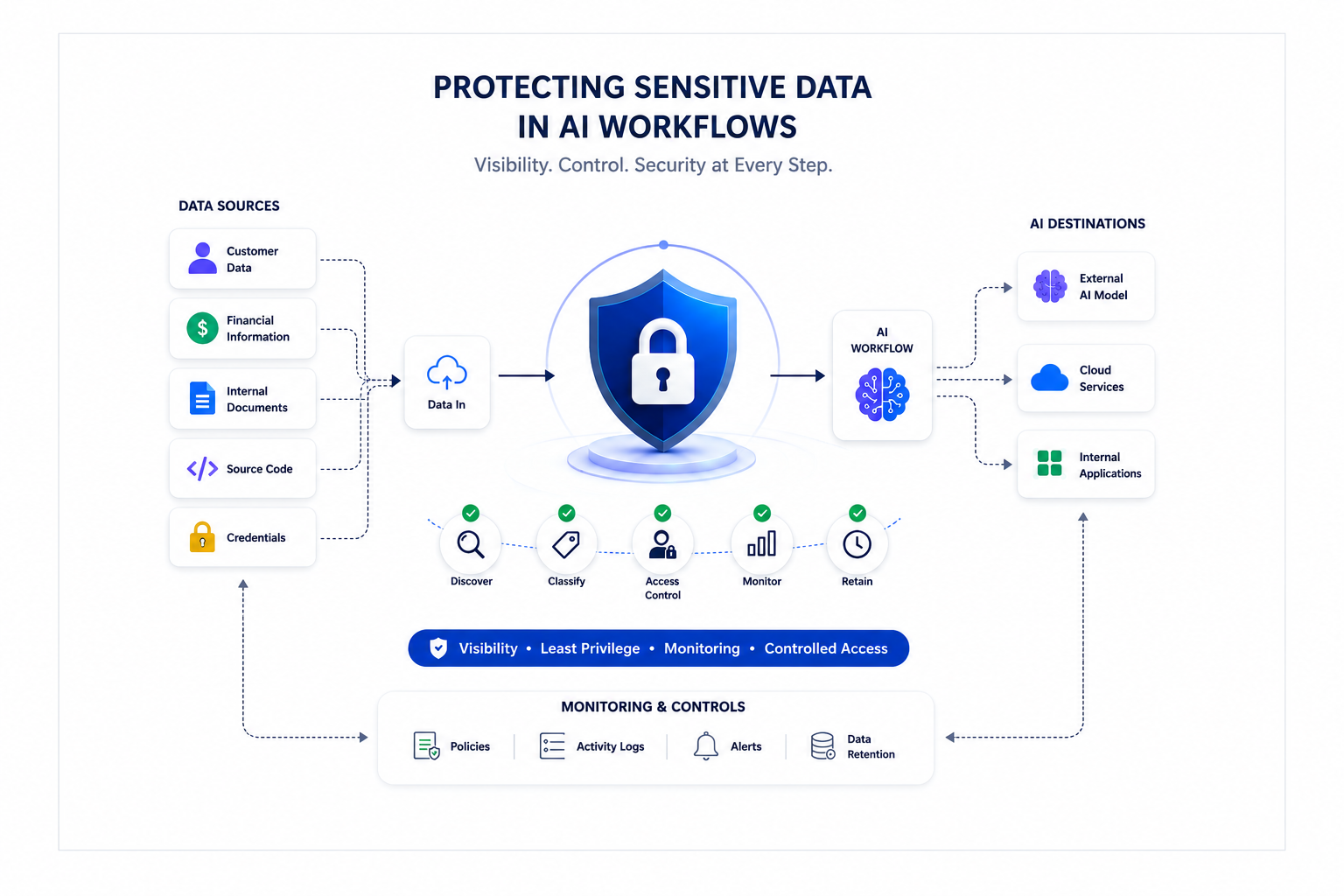
An AI system can process sensitive information in seconds. That might include customer records, financial information, internal documents, source code, credentials, or confidential business data. The problem is that security controls built for traditional applications do not always cover how data moves through AI workflows.
A user may paste information into an AI tool, an application may send data to an external model, or an AI system may store information for later use. Each step creates another place where sensitive data needs to be understood and protected.
Why AI Workflows Create New Data Risks
AI workflows often connect several components: applications, databases, APIs, cloud services, users, models, and third-party platforms.
Sensitive data can move between these components without security teams having complete visibility.
For example, an employee may use an AI assistant to summarize an internal document. The document could contain customer information or confidential business details. If the organization has not clearly defined what data can be shared with the AI service, the workflow creates an avoidable exposure.
The challenge is not simply controlling access to the data. As sensitive data becomes a new security perimeter, security teams also need to understand where sensitive data exists, how it moves, and which AI systems can access it.
Organizations can start by improving data discovery across cloud storage, databases, applications, and AI-connected systems.
Key Security Risks in AI Workflows
Sensitive Data Exposure
AI applications may interact with large amounts of organizational data. If sensitive information is sent to an AI service without appropriate controls, the organization may lose visibility over how that information is processed or retained.
Data classification and clear usage policies can help determine which information is appropriate for AI processing.
Excessive Access
An AI application may have access to more data than it actually needs.
For example, an internal AI assistant designed to answer HR questions may not require access to an entire employee database.
Applying least-privilege access can reduce the potential impact if the application, account, or API connection is compromised.
Data Leakage Through Prompts and Outputs
Sensitive information can enter an AI workflow through user prompts and potentially appear in generated responses.
The risk becomes greater when AI tools are connected to internal knowledge bases, documents, or business applications. A poorly designed permission model could allow users to retrieve information they should not be able to access.
Third-Party and API Risks
Many AI workflows depend on external model providers, APIs, plugins, and SaaS applications. Each integration introduces another data-handling relationship that security teams need to evaluate.
Before connecting sensitive systems to an AI service, teams should understand what information is transmitted, where it goes, how access is controlled, and what logging is available.
Protecting Data Across the AI Lifecycle
Security should not begin after an AI application reaches production.
Teams should consider data protection during:
Discovery → Classification → Access → AI Processing → Monitoring → Retention
This means identifying sensitive information first, limiting access, monitoring how data is used, and reviewing whether information is being retained longer than necessary.
A broader DSPM approach can help organizations understand sensitive-data exposure across their environment and identify where stronger controls are needed.
A Practical Approach for Security Teams
Organizations evaluating AI workflows should focus on a few basic questions:
- What sensitive data can the AI system access?
- Where is that data stored?
- Who can use the AI workflow?
- Which third-party services receive the data?
- Can sensitive information appear in prompts or outputs?
- Are access and usage activities logged?
- How long is the data retained?
- What happens if the AI application or connected account is compromised?
These questions help move AI security discussions beyond the model itself and toward the data surrounding it.
Conclusion
AI can make business processes faster, but the data behind those processes still needs traditional security fundamentals: visibility, classification, least-privilege access, monitoring, and controlled data flows.
The biggest mistake is treating AI as an isolated technology. An AI workflow is part of the organization's wider data environment, and its security depends on understanding what information enters the workflow, where that information travels, and who can access it.
Protecting sensitive data in AI workflows therefore starts with visibility. You cannot protect data consistently if you do not know where it is, how it is being used, or which AI systems can reach it.
About the Author
Sajid Saiyed
Sajid Saiyed leads Cybersecurity Umbrella, driving strategy across cybersecurity services, research, and product innovation. With a focus on building practical, scalable security solutions, he helps organizations strengthen resilience, meet compliance requirements, and confidently navigate an evolving digital landscape.
Is your Cyber Security 2026-Ready?
Stop ransomware and mitigate risks before they happen. Get a free architecture audit from our frontline security analysts.
Schedule a Strategy Call