Data Security Posture Management (DSPM): The Complete Guide
 Tanuj Modi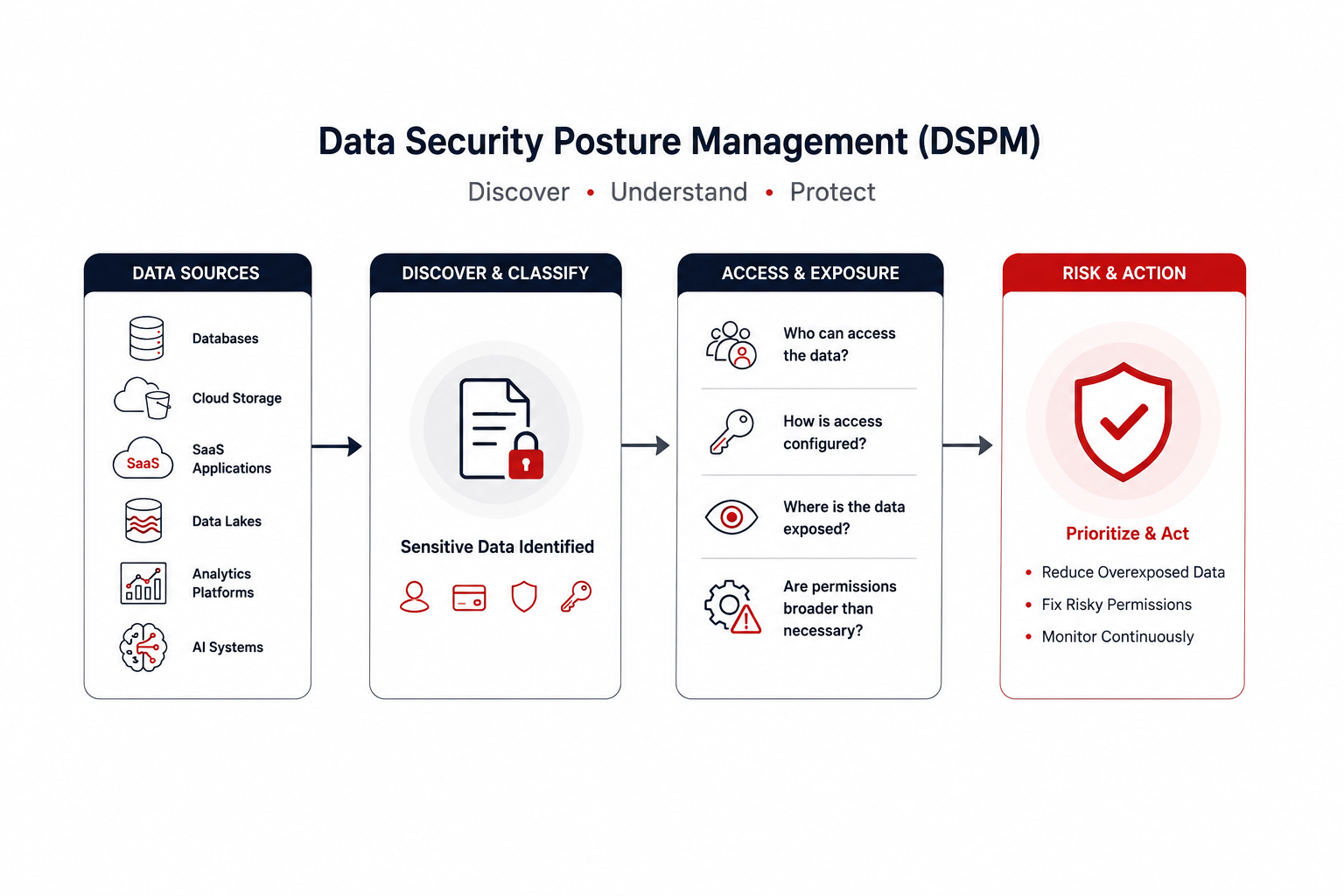
A security team cannot protect sensitive data if it does not know where that data is stored, who can access it, or how it is being used.
That becomes difficult as organizations spread data across cloud storage, databases, SaaS applications, data lakes, analytics platforms, and AI systems. Sensitive information can move between environments quickly, while permissions and configurations change along the way.
Data Security Posture Management (DSPM) helps security teams build visibility into this environment and understand where sensitive data is exposed.
What Is DSPM?
DSPM is a security approach focused on discovering and protecting sensitive data across an organization's environment.
Rather than looking only at infrastructure, DSPM focuses on the data itself.
It can help answer questions such as:
- Where is sensitive data stored?
- What type of data is it?
- Who can access it?
- Is it properly protected?
- Where is it exposed?
- Are permissions broader than necessary?
- Which data stores represent the greatest risk?
This makes DSPM particularly useful for organizations managing large and distributed data environments.
Why Data Visibility Is the Starting Point
Many organizations have more data stores than they realize.
Customer records may exist in a production database, backups, development environments, analytics platforms, and cloud storage. Copies may also be created during testing or data processing.
That is why data discovery is an important part of a broader data security strategy.
Before security teams can reduce risk, they need to know what data exists and where it is located.
How DSPM Identifies Data Risk
DSPM generally combines data discovery, classification, access analysis, and security posture information.
For example, a security team may discover a cloud storage location containing sensitive customer information.
The storage itself may not be the problem.
The real concern could be that:
- Too many users have access.
- The data is exposed to unnecessary systems.
- Sensitive information is stored without appropriate controls.
- The environment has weak security configurations.
- The data is copied into locations that are difficult to monitor.
DSPM helps connect these conditions so teams can focus on meaningful exposure rather than simply counting data stores.
A Practical Enterprise Example
Consider a company storing customer information in a cloud database.
A DSPM assessment identifies the database as containing sensitive information. Further analysis shows that several users and service accounts have access, including accounts that no longer require it.
The security team can now address the actual risk by reviewing permissions, removing unnecessary access, and applying appropriate controls.
Without data-level visibility, the database may simply appear as another cloud resource.
DSPM and AI Workloads
AI introduces another data-security challenge.
Organizations may use sensitive business information in AI applications, analytics pipelines, retrieval systems, or model development workflows.
That makes sensitive data in AI workflows an important consideration for security teams.
The question is no longer only where data is stored. Teams also need to understand where sensitive information is being processed, copied, or made accessible.
What Security Leaders Should Look For
A practical DSPM strategy should provide:
- Data discovery: visibility into relevant data stores.
- Data classification: identification of sensitive information.
- Access visibility: understanding who and what can access the data.
- Exposure analysis: identification of risky configurations and access paths.
- Risk prioritization: focus on data stores with the greatest business impact.
- Continuous monitoring: visibility as data, users, and environments change.
The goal is not to create another inventory.
It is to help security teams answer a more useful question:
Which data is most exposed, and what should we fix first?
Conclusion
DSPM shifts data security from simply protecting infrastructure to understanding the data that infrastructure contains.
Discovery shows where sensitive information exists. Classification explains what makes it important. Access analysis shows who can reach it, while posture and exposure analysis help identify where protection may be insufficient.
For organizations managing data across cloud, SaaS, analytics, and AI environments, that visibility can make security decisions far more focused.
The strongest DSPM strategy is not about finding every possible issue. It is about understanding where sensitive data matters most, how it is exposed, and what action will reduce the greatest risk.
About the Author
Tanuj Modi
Tanuj Modi is a GRC Manager focused on cybersecurity governance, risk management, regulatory compliance, and security frameworks. His work explores the intersection of security, compliance, and business risk.
Is your Cyber Security 2026-Ready?
Stop ransomware and mitigate risks before they happen. Get a free architecture audit from our frontline security analysts.
Schedule a Strategy Call