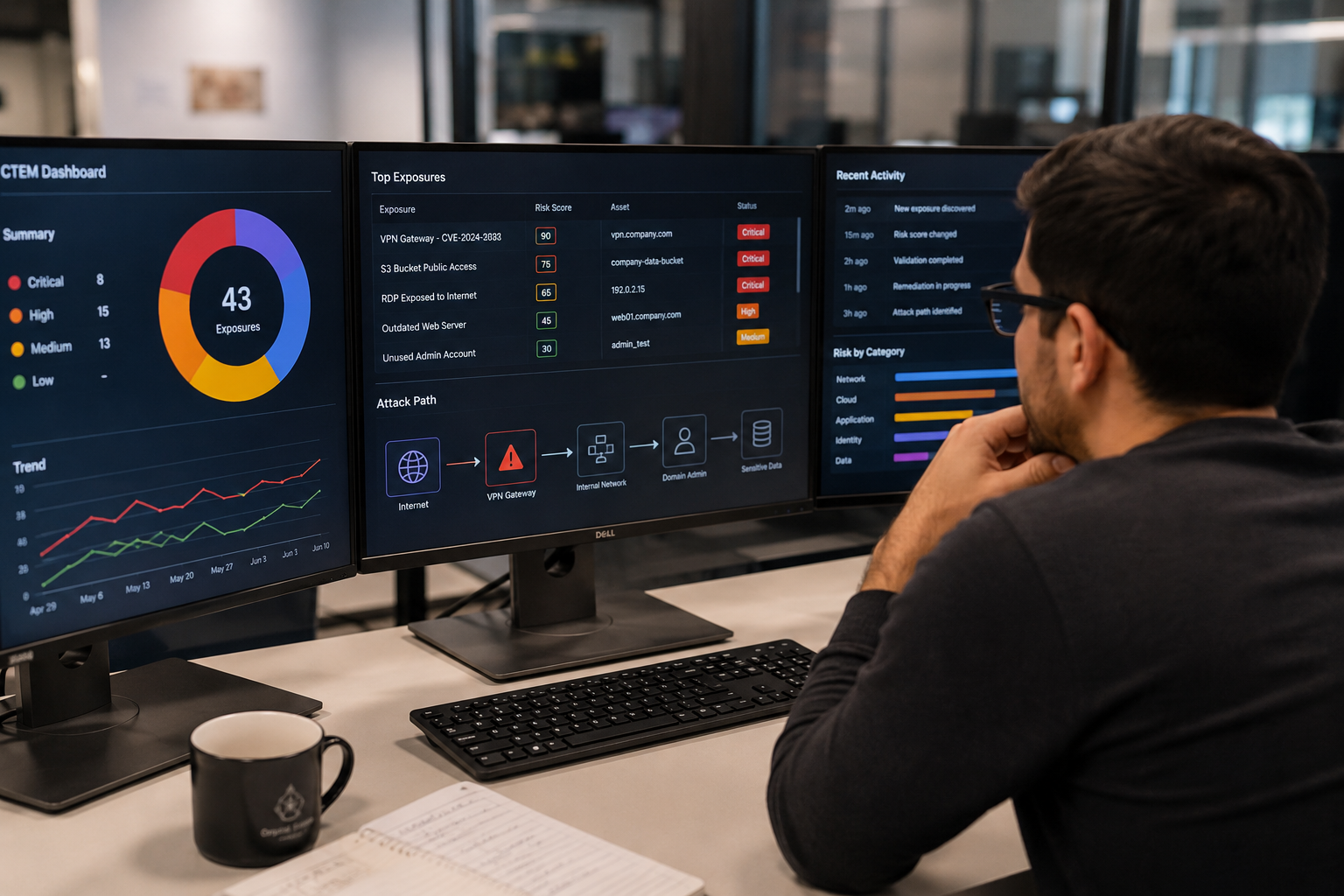
A vulnerability scanner can produce thousands of findings. An external attack surface scan can uncover systems nobody realized were exposed. A penetration test can reveal an attack path that was invisible in a vulnerability report.
The difficult part is not finding security issues. It is deciding which exposures create meaningful risk to the business and what should happen next.
That is the problem Continuous Threat Exposure Management (CTEM) is designed to address.
CTEM provides a structured, repeatable approach for understanding an organization's exposure, prioritizing what matters, validating whether an exposure can actually be used by an attacker, and moving the right teams toward remediation. Gartner describes CTEM as an iterative approach built around five stages: scoping, discovery, prioritization, validation, and mobilization.
Rather than treating security findings as isolated tickets, CTEM asks a more useful question:
Which weaknesses could realistically help an attacker reach something important, and what can we do about them?
What Is Continuous Threat Exposure Management?
Continuous Threat Exposure Management is a security program for continuously identifying and reducing an organization's most meaningful exposures.
The word continuous matters.
An organization’s environment changes every day. New cloud workloads are deployed, applications are updated, identities are created, vendors are connected, firewall rules change, and previously unknown internet-facing systems can appear. A security assessment that was accurate three months ago may no longer represent the current environment.
CTEM therefore moves away from the idea of performing a security assessment once and considering the job finished.
Instead, it creates a recurring cycle:
Scope → Discover → Prioritize → Validate → Mobilize → Repeat
The goal is not to eliminate every possible security issue. That is rarely practical. The goal is to consistently reduce the exposures that present the greatest realistic risk.
Why Traditional Vulnerability Management Is Not Enough
Vulnerability management remains an important part of cybersecurity. The problem comes when vulnerability severity becomes the primary measure of risk.
Consider two findings:
- A high-severity vulnerability exists on an isolated internal test server with no sensitive data.
- A medium-severity vulnerability exists on an internet-facing application connected to a privileged identity and a critical database.
If the security team works strictly from severity ratings, the first finding may receive more attention.
From an attacker's perspective, the second could be much more valuable.
This is why exposure management looks beyond individual vulnerabilities. Gartner notes that organizations need to move beyond vulnerability-centric approaches because prioritized vulnerability lists alone do not cover the full range of exposures or provide enough context for actionable remediation.
Exposure can come from many sources, including:
- Vulnerable software
- Misconfigurations
- Exposed cloud resources
- Weak or excessive permissions
- Compromised credentials
- Internet-facing assets
- Security control gaps
- Third-party connections
- Unmanaged or unknown assets
- Attack paths between systems
A CTEM program brings these pieces together so teams can evaluate risk in context.
The Five Stages of a CTEM Program
Gartner's CTEM model consists of five connected stages: scoping, discovery, prioritization, validation, and mobilization.
These stages should not be treated as a one-time checklist. The output of one cycle becomes input for the next.
1. Scoping: Decide What Matters
A CTEM program should not begin with "scan everything."
Start by identifying what the organization actually needs to protect.
That may include:
- Customer-facing applications
- Critical business services
- Sensitive data stores
- Identity infrastructure
- Cloud environments
- Remote access systems
- High-value intellectual property
- Important third-party connections
The scope should also reflect business priorities. A system supporting revenue generation may deserve more attention than a low-impact internal application, even when both contain security weaknesses.
This is where asset visibility becomes important. Security teams cannot effectively manage exposure if they do not have a reasonable understanding of what exists in the environment.
Scoping also helps prevent a common CTEM mistake: trying to solve the entire security problem at once.
A focused initial scope makes it easier to demonstrate measurable risk reduction and expand the program over time.
2. Discovery: Find the Exposures
Once the scope is defined, the next step is finding what could create exposure.
Discovery should combine information from multiple sources rather than relying on a single security tool.
Depending on the environment, this can include:
- Asset inventories
- Vulnerability scanners
- Cloud security tools
- Identity systems
- Configuration assessments
- External attack surface monitoring
- Penetration testing
- Security validation tools
- Threat intelligence
- Endpoint and network telemetry
The purpose is to build a more complete picture of how the environment appears from both the defender's and attacker's perspectives.
External exposure deserves particular attention. An asset may be forgotten internally but still reachable from the internet.
That is why attack surface is closely connected to CTEM. Attack surface management helps organizations understand what is exposed and where that exposure exists, while CTEM uses that information as part of a broader risk-prioritization process.
3. Prioritization: Decide What Deserves Attention First
Discovery can produce more findings than a security team can realistically remediate.
Prioritization is where CTEM becomes useful for decision-making.
A practical prioritization model should consider several factors:
Business criticality
How important is the affected system or service?
Exposure
Can an attacker reach it directly or indirectly?
Exploitability
Is exploitation realistic, and is there evidence that attackers are using the technique or vulnerability?
Attack path
Could the exposure provide a route toward something more valuable?
Existing controls
Are security controls already preventing or limiting exploitation?
Identity and privilege
Could exploitation lead to privileged access?
Remediation effort
How difficult is it to reduce the exposure?
Known exploitation should also influence prioritization. CISA maintains a Known Exploited Vulnerabilities catalog based on evidence of active exploitation and recommends organizations prioritize remediation of cataloged vulnerabilities as part of vulnerability management.
The important point is that severity is one input, not the complete answer.
A useful priority score should help answer:
If the team can fix only ten things this week, which ten changes will reduce the most meaningful risk?
4. Validation: Test Whether the Risk Is Real
A security finding is not automatically an exploitable attack path.
Validation provides evidence.
Security teams can use controlled methods such as:
- Penetration testing
- Red-team exercises
- Breach and attack simulation
- Adversary emulation
- Configuration validation
- Controlled exploitation
- Security control testing
The objective is not to attack production recklessly. It is to determine whether an identified exposure can actually translate into meaningful attacker behavior.
For example, imagine an internet-facing server with a known vulnerability. A scanner may report it as high risk.
Validation could reveal that:
1. The vulnerable service is reachable.
2. Exploitation is technically possible.
3. The server has access to an internal identity service.
4. That connection could provide a route toward a sensitive application.
5. Existing controls do not sufficiently block the path.
That is considerably more useful than a scanner finding by itself.
The same process can also produce a different result: perhaps compensating controls prevent exploitation. In that case, the original finding may deserve less urgency.
This is one reason attack paths are valuable within an exposure-management program. Instead of viewing weaknesses independently, attack path analysis helps security teams understand how individual exposures can connect.
5. Mobilization: Turn Findings Into Action
Even a perfectly prioritized security finding has little value if nobody owns it.
Mobilization connects security findings to the teams that can actually reduce the exposure.
That may involve:
- Security operations
- Infrastructure teams
- Cloud teams
- Application developers
- Identity teams
- Network teams
- IT operations
- Risk management
- Business owners
The handoff should contain enough context to make remediation practical.
Instead of:
"Critical vulnerability detected. Patch immediately."
A useful CTEM finding might explain:
"This internet-facing application contains an exploitable weakness. The application has access to a privileged service account, creating a potential route toward a business-critical database. Patch the application or remove the unnecessary privileged connection."
The second message gives the responsible team a reason, an impact, and a direction.
Gartner's CTEM guidance emphasizes mobilization because remediation often depends on cross-team ownership, approvals, and operational constraints rather than security tools alone.
About the Author

Nilesh Tank
Nilesh Tank is a VAPT Lead focused on penetration testing, vulnerability management, attack simulation, and offensive security. His expertise spans identifying security weaknesses and improving organizational security posture through proactive testing.
Is your Cyber Security 2026-Ready?
Stop ransomware and mitigate risks before they happen. Get a free architecture audit from our frontline security analysts.
Schedule a Strategy Call