Cloud Misconfigurations: How Small Errors Become Security Incidents
 Jenish Babariya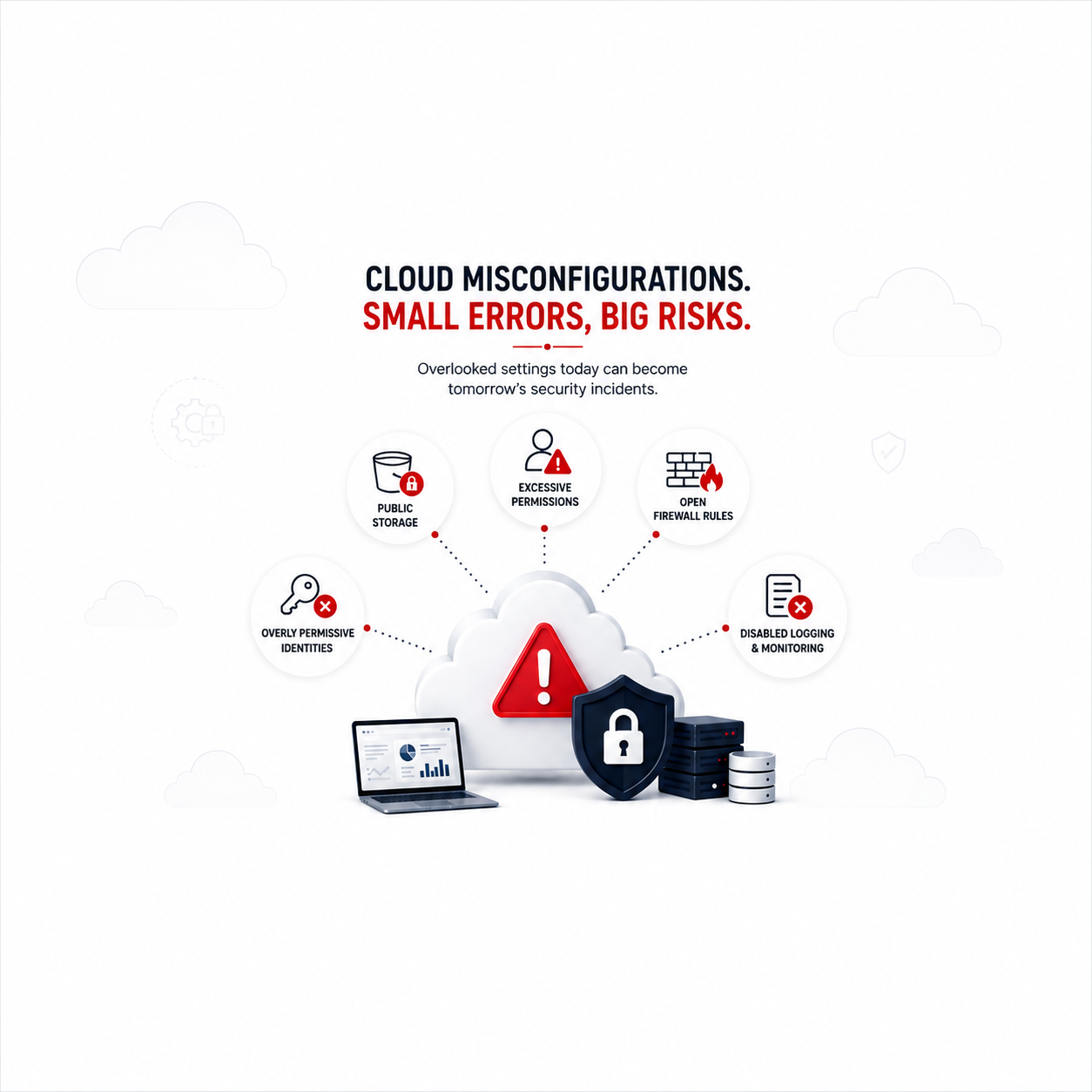
A cloud security incident does not always require an advanced attack technique. Sometimes, an overlooked setting is enough.
A storage bucket with unintended public access, an overly permissive identity role, or a firewall rule that allows more traffic than necessary can create an opening for attackers. The difficult part is that these issues often come from routine cloud operations rather than deliberate security failures.
As organizations deploy more applications and infrastructure in the cloud, configuration itself becomes an important part of the security perimeter.
What Is a Cloud Misconfiguration?
A cloud misconfiguration occurs when a cloud resource, service, identity, or security control is configured in a way that creates unnecessary security exposure.
Some common examples include:
- Publicly accessible storage containing business or sensitive information
- Excessive permissions assigned to users, applications, or service accounts
- Security groups or firewall rules allowing unnecessary inbound access
- Logging and monitoring controls that are disabled or incomplete
- Cloud resources deployed without appropriate encryption
- Default credentials or security settings left unchanged
- Development environments connected too broadly to production resources
- Unused accounts, services, or permissions that remain active
None of these problems necessarily looks like a major security incident on its own. The risk becomes more serious when one weakness can be combined with another.
How a Small Configuration Error Can Escalate
Imagine an organization running a customer-facing application in the cloud. The application is protected by authentication, and the underlying server is regularly patched.
However, the workload has been assigned a cloud identity with permissions far beyond what the application actually needs.
If an attacker compromises that application, they may inherit those permissions. What started as an application compromise could then become unauthorized access to storage, databases, secrets, or other cloud services.
The important lesson is that security risk depends on context.
A misconfiguration affecting an isolated test environment is different from one affecting a production database or a privileged identity.
Why Cloud Misconfigurations Are So Common
Cloud environments change quickly. Developers create resources, infrastructure teams modify network rules, applications receive new permissions, and automated pipelines deploy changes throughout the day.
That speed is one of the major benefits of cloud computing, but it also creates security challenges.
A configuration that was appropriate when a resource was created may no longer be appropriate after the environment changes. Manual reviews can easily miss these changes, particularly when an organization operates across multiple cloud accounts, subscriptions, regions, and services.
This makes continuous visibility important.
Security teams need to know not only what exists, but also how it is configured, who can access it, and what it can reach.
Misconfiguration Is More Than a Compliance Problem
Cloud misconfigurations are sometimes treated primarily as compliance findings. Compliance is important, but security teams should also consider the potential attack scenario.
For example, an externally accessible resource containing non-sensitive test data may represent a different level of risk from an exposed storage service containing customer information.
Similarly, an overly broad permission assigned to a low-privileged user may be less concerning than the same permission assigned to a production workload with access to critical systems.
This is why cloud security requires prioritization rather than simply producing a long list of configuration findings.
How Security Teams Can Reduce Cloud Misconfiguration Risk
A practical approach starts with a few fundamentals.
1. Maintain Cloud Asset Visibility
Security teams cannot protect resources they do not know exist. Maintain an accurate inventory of cloud accounts, workloads, storage resources, identities, databases, and externally exposed services.
2. Apply Least Privilege
Permissions should match actual business and application requirements. Remove unnecessary privileges and regularly review service accounts and workload identities.
3. Monitor External Exposure
Regularly identify resources that are reachable from the internet. Pay particular attention to sensitive applications, databases, management interfaces, and storage.
4. Detect Configuration Changes
Configuration drift can introduce risk after deployment. Monitoring changes helps security teams identify unexpected or potentially dangerous modifications before they become larger problems.
5. Standardize Secure Deployments
Infrastructure-as-code templates and approved configuration baselines can reduce the likelihood of recurring security mistakes.
6. Prioritize Risk by Context
Not every finding deserves the same urgency. Consider factors such as:
- Internet exposure
- Data sensitivity
- Identity privileges
- Business criticality
- Exploitability
- Connections to other resources
This approach helps teams focus remediation efforts where they can reduce the most meaningful risk.
Where Cloud Detection Fits
Finding a misconfiguration is only the first step. Security teams also need to determine whether the issue was exploited, what resources were affected, and whether suspicious activity followed the configuration change.
That makes cloud detection and response an important part of the broader cloud security process.
For organizations evaluating cloud security platforms, cloud security posture management provides useful context on how different approaches address configuration, workload, and cloud-native security risks.
A Simple Cloud Misconfiguration Checklist
Before considering a cloud environment as well controlled, security teams should be able to answer:
- Do we know what cloud resources exist?
- Which resources are publicly accessible?
- Who can access sensitive resources?
- Are permissions broader than necessary?
- Are configuration changes being monitored?
- Are unused identities and services removed?
- Are logging and detection controls enabled?
- Can the team identify which misconfigurations create the greatest business risk?
If several of these questions cannot be answered confidently, there may be visibility or control gaps worth addressing.
Conclusion
Cloud misconfigurations rarely look dramatic when they first appear. A permission that is slightly too broad or a resource that is unintentionally exposed can seem like a routine administrative issue.
The real concern is what that weakness connects to.
When misconfigurations intersect with sensitive data, privileged identities, exposed services, or critical workloads, a small error can become part of a much larger attack scenario. Effective cloud security therefore requires more than finding configuration problems. It requires understanding their context, monitoring how the environment changes, and prioritizing the exposures that could have the greatest impact.
The objective is simple: make cloud exposure visible, reduce unnecessary access, and address risky configurations before attackers can turn them into security incidents.
About the Author
Jenish Babariya
Jenish Babariya is a cybersecurity professional with experience across SOC operations, digital forensics, and DevOps. His areas of interest include threat detection, incident response, cyber investigations, cloud security, infrastructure automation, and emerging cyber threats.
Is your Cyber Security 2026-Ready?
Stop ransomware and mitigate risks before they happen. Get a free architecture audit from our frontline security analysts.
Schedule a Strategy Call