Why Security Awareness Training Needs to Evolve for AI Threats
 Nilesh Tank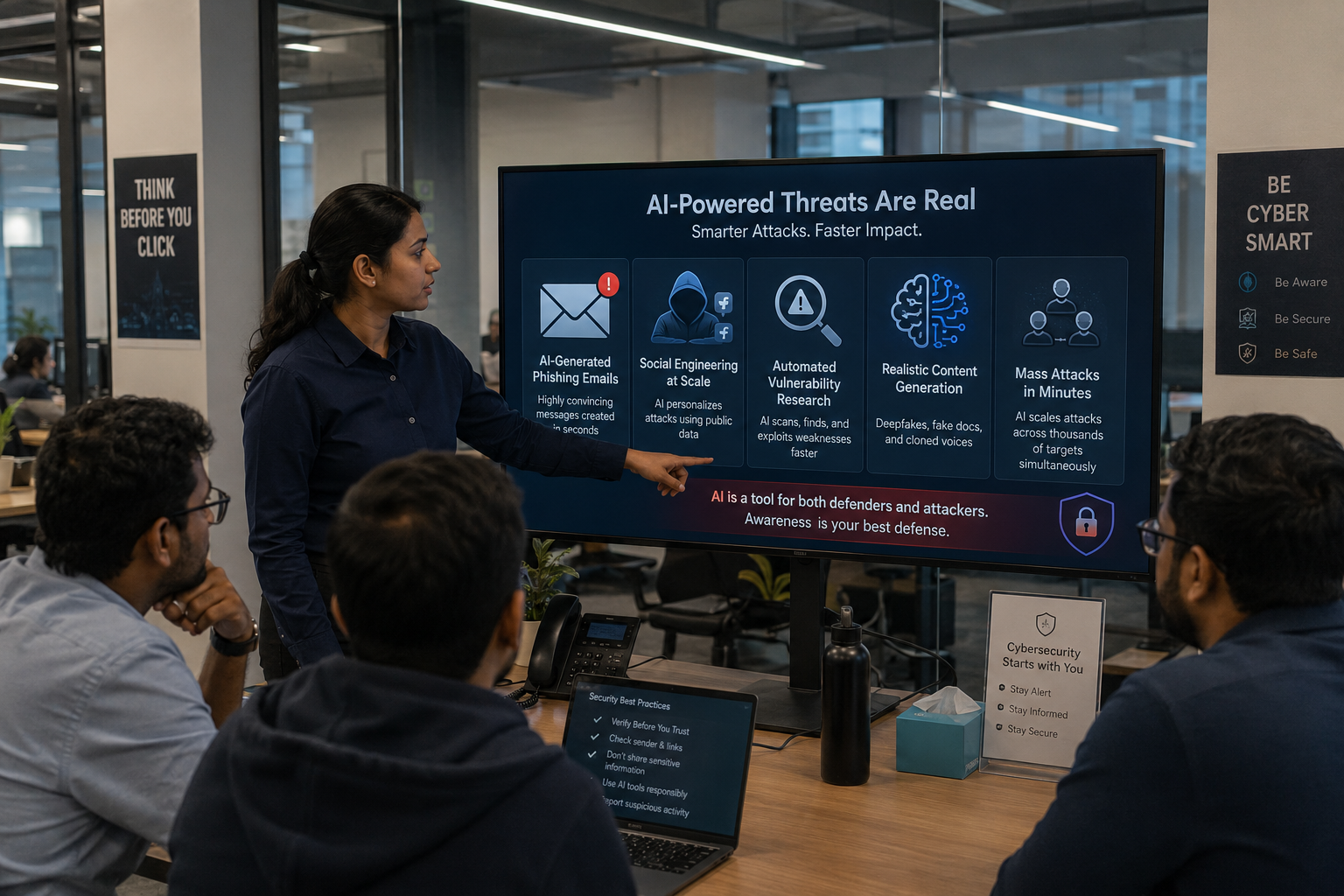
Insights from the World Economic Forum's
Artificial Intelligence (AI) is transforming the way organizations defend themselves against cyber threats. It can detect attacks faster, automate repetitive security tasks, and help security teams respond more efficiently. However, the same technology is also giving cybercriminals new ways to launch faster, more sophisticated, and highly convincing attacks.
This changing landscape means cybersecurity is no longer just about installing better security software. It is also about preparing people to recognize and respond to AI-powered threats.
According to the World Economic Forum's Empowering Defenders: AI for Cybersecurity (2026) report, organizations should view AI as a tool that enhances human capabilities-not one that replaces them. Human judgment, governance, and continuous skill development remain essential for effective cybersecurity.
AI Is Changing the Cybersecurity Landscape
Cyberattacks have become more advanced over the past few years. With generative AI, attackers can automate tasks that previously required significant time and technical expertise.
AI can be used to:
- Create realistic phishing emails within seconds
- Generate personalized messages using publicly available information
- Automate vulnerability research
- Produce convincing social engineering content
- Scale attacks across thousands of targets simultaneously
At the same time, cybersecurity teams are using AI to detect threats faster, analyze large volumes of security data, and improve incident response.
This creates a new reality where both defenders and attackers are using AI. Success no longer depends only on having advanced technology-it also depends on how well people understand and respond to these evolving threats.
Why Traditional Security Awareness Training Needs an Upgrade
For many years, security awareness training focused on common cyber risks such as:
- Creating strong passwords
- Identifying suspicious emails
- Avoiding malicious links
- Following company security policies
These practices are still important.
However, AI-powered attacks are becoming far more convincing than traditional cyber threats. Employees can no longer rely only on obvious warning signs such as poor grammar or suspicious email formatting.
Modern awareness training should help employees develop critical thinking and verification habits rather than simply memorizing security rules.
The goal is not to make employees cybersecurity experts-it is to help them make informed decisions when something feels unusual or unexpected.
Human Judgment Still Matters
One of the key messages from the World Economic Forum report is that AI should augment human decision-making rather than replace it.
AI can process massive amounts of information in seconds, identify unusual patterns, and recommend actions. However, it cannot fully understand business context, organizational priorities, or human intent.
For example, AI might identify an email as low risk based on technical indicators, but an employee may recognize that the request is unusual because it doesn't follow normal business procedures.
This combination of AI-powered technology and human judgment creates stronger cybersecurity than either could achieve alone.
Security Awareness Is Becoming an Essential Business Skill
Cybersecurity is no longer just the responsibility of the IT department.
Every employee interacts with digital systems, cloud applications, emails, collaboration platforms, and increasingly, AI-powered tools.
The WEF report emphasizes that successful AI adoption requires organizations to invest in:
- Employee skills
- AI literacy
- Governance
- Responsible AI practices
- Continuous learning
Security awareness should therefore become part of everyday work rather than an annual compliance requirement.
Employees should understand:
- How AI is changing cyber threats
- Why unusual requests should always be verified
- How to use AI tools responsibly
- When to report suspicious activity
Building awareness helps reduce risk across the entire organization.
AI Requires Responsible Use
As organizations adopt AI, employees are increasingly using AI assistants to summarize documents, generate content, and improve productivity.
While these tools provide significant benefits, they also introduce new responsibilities.
Organizations should provide clear guidance on:
- What information can safely be shared with AI tools
- How confidential business data should be protected
- Which AI applications are approved for workplace use
- Why human review remains important before acting on AI-generated outputs
Responsible AI usage is becoming an important part of modern cybersecurity awareness.
Security Awareness Should Be Continuous
Cyber threats continue to evolve, and AI is accelerating that pace.
This means security awareness cannot remain a once-a-year training session.
Organizations should adopt continuous learning by providing:
- Regular awareness updates
- Practical security scenarios
- AI-focused learning modules
- Interactive phishing simulations
- Short refresher sessions throughout the year
Frequent learning helps employees stay informed about new attack techniques and emerging risks.
Building a Security-First Culture
Technology alone cannot protect an organization.
Even the most advanced AI-powered security tools depend on people making informed decisions.
A strong cybersecurity culture encourages employees to:
- Ask questions before acting.
- Verify unexpected requests.
- Report suspicious activity without hesitation.
- Continue learning about emerging cyber risks.
- Use AI responsibly and ethically.
When employees feel confident about identifying and reporting threats, they become an organization's strongest defense.
Final Thoughts
Artificial Intelligence is transforming cybersecurity by helping organizations detect and respond to threats faster, while also enabling cybercriminals to launch more sophisticated AI-powered attacks. As highlighted in the World Economic Forum's Empowering Defenders: AI for Cybersecurity (2026) report, the future of cybersecurity lies in combining AI's speed and analytical capabilities with human judgment, critical thinking, and responsible decision-making.
To stay ahead, organizations must move beyond traditional, once-a-year security awareness training and invest in continuous learning, AI literacy, and a strong security-first culture. Cybersecurity is no longer just an IT responsibility, every employee plays a vital role in protecting the organization.
If you're looking to build a more cyber-aware workforce, Cybersecurity Umbrella's Security Awareness Training (AWT) helps organizations prepare employees for AI-powered threats through continuous learning, phishing simulations, and practical, real-world cybersecurity training.
About the Author
Nilesh Tank
Nilesh Tank is a VAPT Lead focused on penetration testing, vulnerability management, attack simulation, and offensive security. His expertise spans identifying security weaknesses and improving organizational security posture through proactive testing.
Is your Cyber Security 2026-Ready?
Stop ransomware and mitigate risks before they happen. Get a free architecture audit from our frontline security analysts.
Schedule a Strategy Call