When AI Agents Become Employees: Who Is Responsible for Their Security?
 Sajid Saiyed
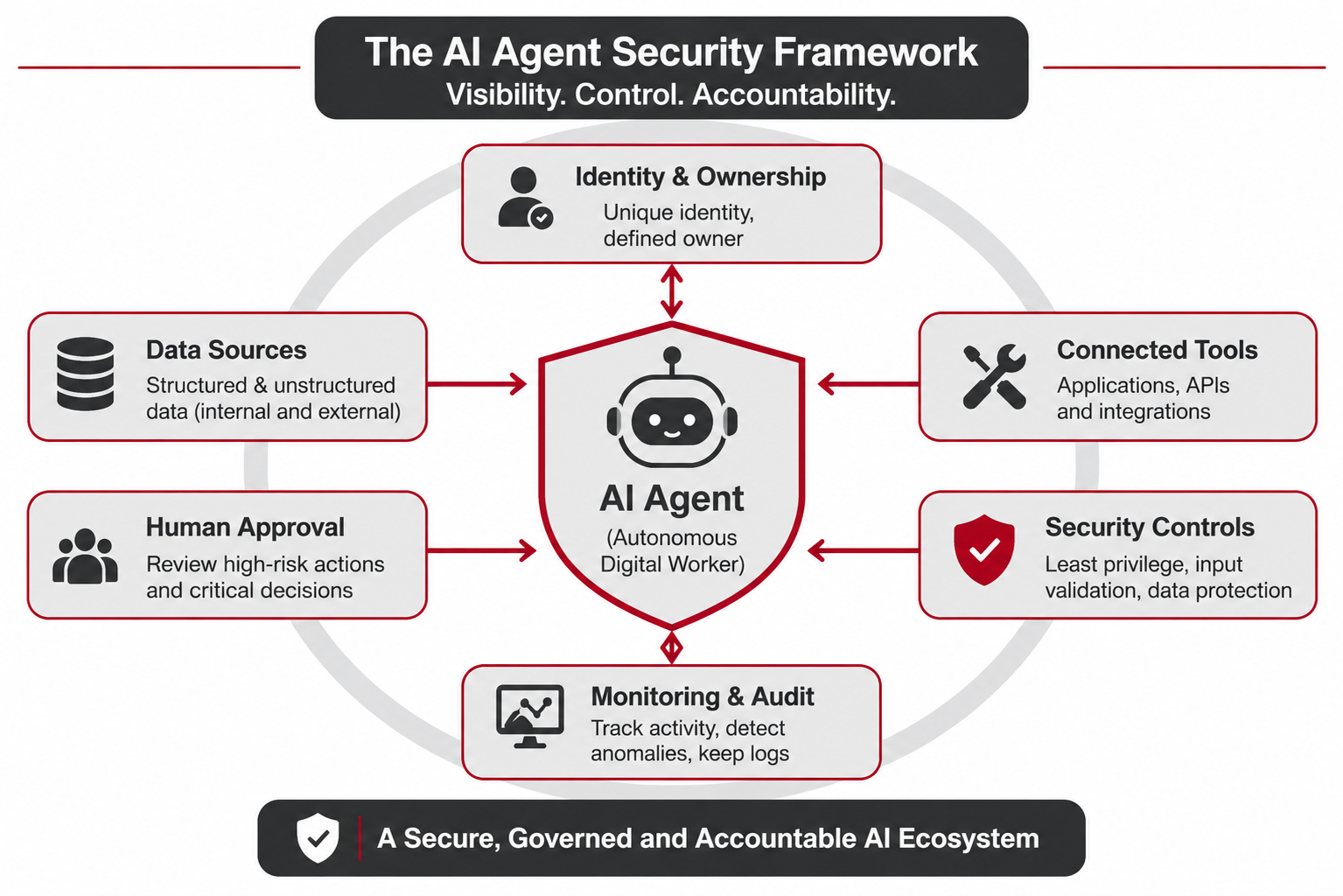
Artificial intelligence is moving beyond answering questions and generating content. Businesses are beginning to deploy AI agents that can manage workflows, analyse information, communicate with customers, access internal systems and execute tasks with limited human intervention.
An AI agent can review a supplier's documents, retrieve information from a company's database, prepare a report and send it to the relevant team. Another might monitor cloud infrastructure, investigate alerts or initiate operational workflows.
These capabilities introduce a different kind of cybersecurity challenge.
Traditional software generally follows predefined instructions. AI agents, however, can interpret information, plan multiple steps, select tools and take actions based on their objectives. They may also operate across several business systems using assigned identities and permissions.
This raises an important question for organizations: When an AI agent makes a mistake, exposes sensitive information or performs an unauthorized action, who is responsible?
The answer is not simply the AI developer or the technology provider. Responsibility is shared across the organization, its technology partners and the teams responsible for deploying and governing the agent.
What Happens When AI Agents Start Acting Independently?
An AI agent is a software system that uses artificial intelligence to understand a goal, make decisions, interact with tools and complete tasks through a sequence of actions.
Unlike a conventional chatbot, which primarily responds to user instructions, an AI agent can take action through connected applications and services.
For example, consider an AI procurement agent responsible for reviewing vendor information.
It might:
- Retrieve supplier documents from an internal repository.
- Compare security certifications and contractual requirements.
- Identify potential compliance gaps.
- Update a vendor risk register.
- Notify the procurement team about high-risk findings.
Each step involves access to business information, connected applications, and potentially sensitive operations.
The security concern is not just whether the agent provides an inaccurate answer. It is whether the agent has the authority to act on that answer.
If an agent has excessive permissions, a manipulated instruction or compromised integration could lead to unauthorized access, data exposure or unintended business activity.
This is why AI agent security needs to be treated as an extension of enterprise cybersecurity, not simply an additional feature of an AI application.
Why AI Agent Security Creates New Cybersecurity Risks?
AI agents combine several capabilities that were traditionally managed through separate security controls: identity, access, data, automation and decision-making.
When these capabilities operate together, the potential impact of a security weakness can increase.
1. Excessive permissions and uncontrolled access
AI agents often need access to business applications to perform their assigned tasks. However, organizations may grant broader permissions than necessary to make integrations easier.
The issue applies to agents connected to email platforms, cloud environments, customer databases, and enterprise applications.
Organizations should apply the principle of least privilege: each agent should receive only the permissions required for its specific task, with access reviewed.
2. Prompt injection and manipulated instructions
AI agents process information from users, websites, emails, documents and connected applications. Not all of this information is trustworthy.
An attacker could place malicious instructions inside a document or webpage that an agent is expected to read. If the agent interprets those instructions as commands rather than untrusted content, it may be manipulated into performing unintended actions.
3. Uncontrolled agent-to-agent communication
Some organizations are experimenting with multiple AI agents working together.
One agent may collect information, another may analyse it, and a third may execute a task based on the results.
While this approach can improve workflow efficiency, it also introduces additional trust boundaries.
If one agent is compromised or produces manipulated information, other agents may act on that output without independently validating it.
Every agent-to-agent interaction should therefore have defined authorization, validation and logging controls.
4. Limited visibility and accountability
A conventional application typically has identifiable users, system events and access logs. AI agents introduce more complicated activity patterns because they can perform multiple actions across different systems during one task.
If an agent modifies a record, sends an email or accesses a sensitive document, security teams need to understand:
- Which agent performed the action?
- Who initiated or authorized the task?
- What information influenced the decision?
- Which tools and applications were accessed?
- What permissions were used?
- Can the action be reversed or contained?
Without this level of visibility, investigating an incident becomes more difficult.
Who Is Responsible for AI Agent Security?
There is no single team that can secure an AI agent independently. Responsibility depends on how the agent is developed, deployed and integrated into the business.
However, organizations should establish clear ownership before allowing agents to operate in production environments.
1. Business Leadership: Defining Accountability
Business leaders must decide where AI agents can be deployed, define acceptable risks and assign an accountable owner to each agent.
2. IT and Security Teams: Controlling Access
IT and security teams must ensure agents operate within approved boundaries.
3. Developers and AI Teams: Building Security In
Developers must secure how agents process information, use tools and connect to external systems.
4. Technology Providers: Securing the Platform
Technology providers are responsible for securing the infrastructure and services they deliver.
What Organizations Should Consider Before Deploying AI Agents?
Before introducing autonomous agents into business-critical workflows, organizations should assess whether their existing cybersecurity controls are ready to manage them.
A useful starting point is to ask:
1. Do we have an inventory of all AI agents currently in use?
2. Does every agent have a named business owner?
3. Are agent identities separate from employee and shared service accounts?
4. Are permissions limited to the agent's actual responsibilities?
5. Can we identify every tool, API and data source an agent can access?
6. Are high-impact actions subject to approval?
7. Can we monitor and investigate agent activity?
8. Do we have a process to disable an agent and revoke its access?
9. Are third-party AI services and integrations assessed for security risks?
10. Are AI agents included in our risk management and incident response processes?
If these questions cannot be answered confidently, the organization may be expanding automation faster than its security and governance capabilities.
The Future of Enterprise Security Will Include AI Agent Governance
AI agents are becoming part of everyday business operations. Their ability to work across applications, access information and execute tasks can improve efficiency, but it also changes how organizations must think about cybersecurity.
The central challenge is not simply protecting the AI model. It is controlling the identity, permissions, data, tools and decisions surrounding the agent.
Organizations need to know what each agent is allowed to do, who is accountable for its actions and how its activity can be monitored or stopped when something goes wrong.
AI agents may increasingly perform responsibilities that once belonged to employees, but they should never operate without the accountability expected of business-critical
The organizations that benefit most from agentic AI will not necessarily be those that deploy the most agents. They will be those that can use autonomous systems while maintaining visibility, control and accountability.
At Cybersecurity Umbrella, we help organizations strengthen cybersecurity governance, assess security gaps and manage enterprise risk. As AI adoption expands, understanding and governing new technology-related risks is becoming an important part of building a resilient security program.
Explore our Advisory & Assurance services and CXO Risk platform to learn more about strengthening your organization's security and risk management practices.
About the Author
Sajid Saiyed
Sajid Saiyed leads Cybersecurity Umbrella, driving strategy across cybersecurity services, research, and product innovation. With a focus on building practical, scalable security solutions, he helps organizations strengthen resilience, meet compliance requirements, and confidently navigate an evolving digital landscape.
Is your Cyber Security 2026-Ready?
Stop ransomware and mitigate risks before they happen. Get a free architecture audit from our frontline security analysts.
Schedule a Strategy Call