CNAPP Explained: What Security Leaders Need to Know
 Jenish Babariya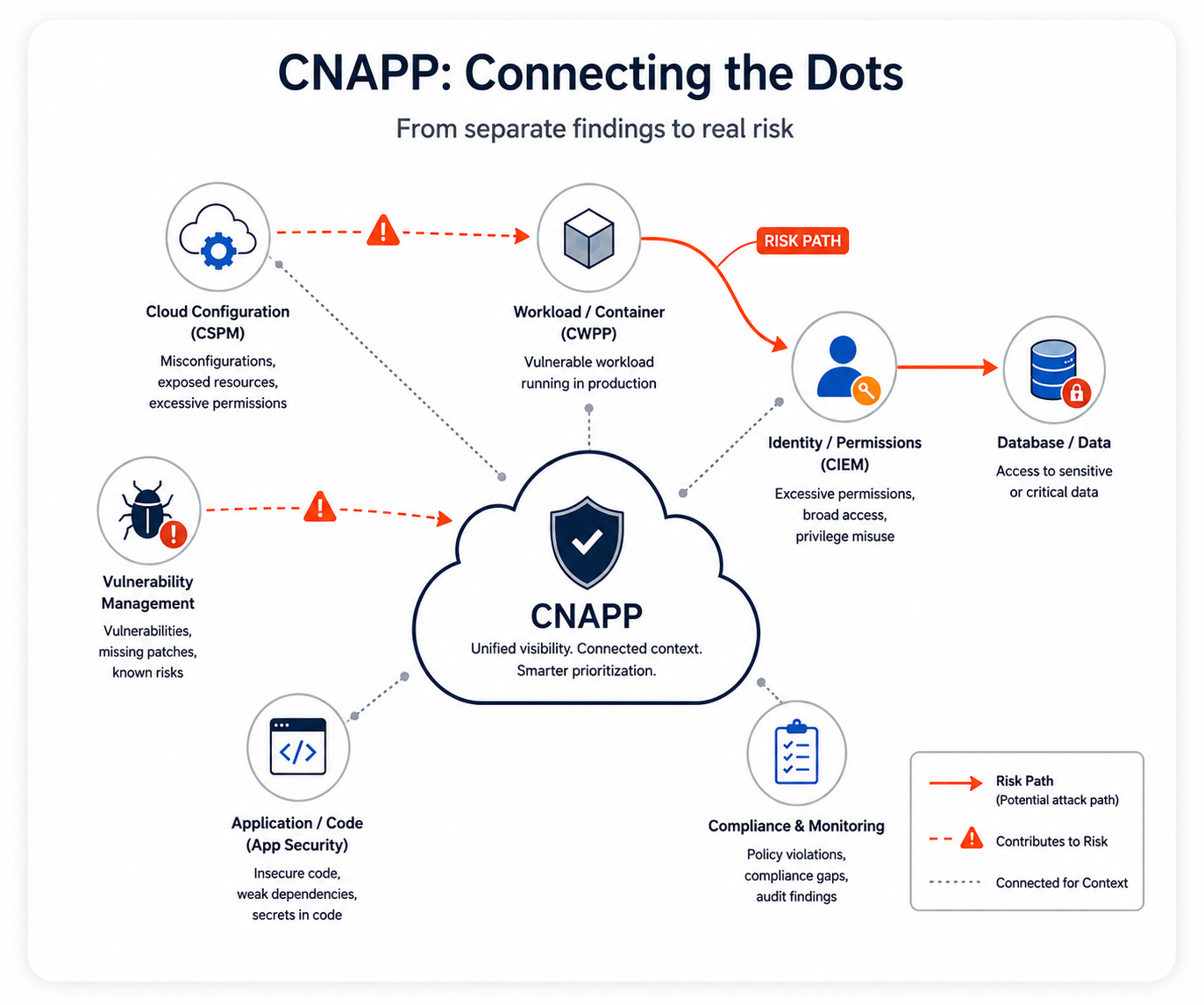
A cloud security team can easily end up with one tool for misconfigurations, another for workloads, another for identities, and another for vulnerabilities. Each may work well independently, but the real challenge begins when security teams need to connect those findings.
A vulnerable workload may have excessive permissions, access a sensitive database, and be exposed through a cloud misconfiguration. Individually, these issues may look manageable. Together, they could create a meaningful attack path.
Cloud-Native Application Protection Platforms (CNAPPs) bring these security areas together to provide better context around cloud risk.
What Is CNAPP?
CNAPP stands for Cloud-Native Application Protection Platform. It combines multiple security capabilities across the cloud application lifecycle, from development to runtime.
Depending on the platform, capabilities may include:
- Cloud Security Posture Management (CSPM)
- Cloud Workload Protection
- Cloud Infrastructure Entitlement Management (CIEM)
- Vulnerability management
- Container and Kubernetes security
- Infrastructure-as-Code security
- Secrets detection
- Runtime threat detection
The goal is not simply to put several tools into one dashboard. The bigger benefit is connecting findings so security teams can understand which issues actually create meaningful risk.
Why CNAPP Matters
Cloud applications depend on containers, APIs, databases, service accounts, storage, infrastructure-as-code, and other interconnected services.
A weakness in one area can become more serious because of another.
For example, a vulnerable container may not be an immediate priority if it is isolated. But if that container is internet-facing, runs in production, has excessive permissions, and can access sensitive data, the risk changes significantly.
CNAPP helps provide this broader context.
The Core Capabilities of CNAPP
CSPM identifies cloud configuration and posture problems such as exposed storage, insecure network settings, and excessive permissions.
Workload protection focuses on virtual machines, containers, Kubernetes environments, and other workloads, helping identify vulnerabilities and suspicious activity.
Identity and entitlement security helps determine who has access, what they can access, and where privileges may be excessive.
Application and infrastructure security can assess Infrastructure-as-Code, container images, dependencies, and secrets before deployment.
Runtime detection and response helps identify suspicious activity after applications are deployed. This connects closely with Cloud Detection and Response .
CNAPP's Real Value: Connecting the Dots
Consider a production container with a serious vulnerability. Its service account has broad permissions, the workload can reach sensitive storage, and the application is exposed to the internet.
A traditional security workflow may treat these as separate findings.
CNAPP can help connect them and answer a more useful question:
Could these conditions create a realistic path to something valuable?
That context allows teams to prioritize risks based on exposure and potential impact rather than severity alone.
CNAPP vs. CSPM vs. CWPP
The terms can overlap, but their focus differs.
CSPM focuses on cloud configuration and posture.
CWPP focuses on workload protection.
CIEM focuses on identity permissions.
CNAPP brings multiple cloud-native security capabilities together.
For a deeper comparison, see CSPM vs CNAPP vs CWPP.
How Security Leaders Should Evaluate CNAPP
Security leaders should look beyond the feature list and ask:
- Can the platform provide broad cloud visibility?
- Can it connect vulnerabilities, identities, configurations, and exposures?
- Can it prioritize risks based on context?
- Can it identify issues before deployment?
- Can it detect suspicious runtime activity?
- Can it support multi-cloud environments?
- Can it integrate with existing SOC and DevOps workflows?
- Does it help teams understand how to remediate issues?
A CNAPP should reduce complexity, not simply generate more findings.
Conclusion
CNAPP is best understood as a connected approach to cloud security.
Its value comes from bringing configuration, workloads, identities, vulnerabilities, development security, and runtime activity into a broader view of risk.
The goal is to move beyond:
"We found a vulnerability."
and toward:
"We understand where it sits, what it can reach, how it could be exploited, and what should be fixed first."
For security teams managing complex cloud environments, that context can make cloud security more focused, practical, and actionable.
About the Author
Jenish Babariya
Jenish Babariya is a cybersecurity professional with experience across SOC operations, digital forensics, and DevOps. His areas of interest include threat detection, incident response, cyber investigations, cloud security, infrastructure automation, and emerging cyber threats.
Is your Cyber Security 2026-Ready?
Stop ransomware and mitigate risks before they happen. Get a free architecture audit from our frontline security analysts.
Schedule a Strategy Call