Cloud Detection and Response (CDR): A Practical Guide
 Jenish Babariya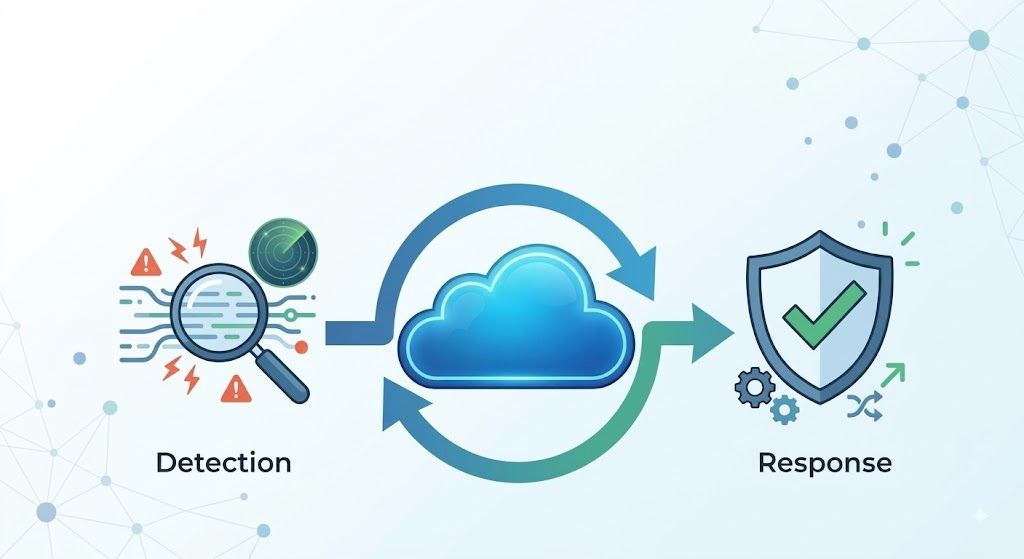
A cloud security dashboard can tell you that a storage bucket is misconfigured or an identity has excessive permissions. What it may not tell you is whether someone is actively abusing that weakness right now.
That distinction matters.
Cloud environments are dynamic. Resources appear and disappear, identities can access services through APIs, workloads may be short-lived, and a single compromised credential can affect resources across an environment.
Cloud Detection and Response (CDR) focuses on what is happening inside the cloud: detecting suspicious activity, investigating what happened, and responding before an incident spreads.
CDR is best understood as a runtime security capability that complements preventive and posture-focused controls. It brings cloud-specific telemetry and context into the detection and response process rather than treating the cloud as simply another collection of servers.
What Is Cloud Detection and Response?
Cloud Detection and Response is the practice of continuously monitoring cloud environments for signs of malicious or suspicious activity and taking appropriate action when threats are identified.
The exact implementation varies, but CDR commonly looks across three areas:
- Cloud control plane: API calls, administrative changes, identity activity, and configuration changes.
- Cloud workloads: Virtual machines, containers, serverless workloads, and applications.
- Identity activity: User accounts, service accounts, roles, tokens, and authentication behavior.
This gives security teams visibility into activity that traditional endpoint-focused tools may not fully capture.
For example, an attacker may not need to install malware on a server. They could compromise an identity, obtain access to cloud APIs, change permissions, create a new access key, or access sensitive resources.
The activity may happen almost entirely through legitimate cloud mechanisms.
That is one of the central challenges CDR is designed to address.
Why Cloud Environments Need a Different Detection Approach
Traditional security monitoring was built around relatively stable infrastructure: endpoints, servers, network segments, and perimeter controls.
Cloud environments change that model.
A workload can be created automatically, scaled across multiple instances, moved between services, or removed after a short period. At the same time, identities and APIs become central to how infrastructure is managed.
Google Cloud notes that the move to public and hybrid cloud changes the threat landscape, the technology environment, and the methods required for threat detection.
This creates several challenges.
Short-lived resources
A workload that exists for only a few hours may still be compromised during that period. If security monitoring depends on a static asset inventory, important activity can be missed.
Identity-driven attacks
Cloud access is heavily dependent on identities and permissions. A compromised user or service identity can sometimes access resources without an attacker needing to exploit a traditional software vulnerability.
API-heavy environments
Cloud infrastructure is managed through APIs. Administrative actions such as creating resources, changing permissions, modifying security controls, or accessing data can all generate useful security signals.
Distributed environments
An organization may operate across multiple cloud accounts, subscriptions, regions, providers, and on-premises systems. Security teams need to understand activity across those boundaries.
CDR vs. Cloud Security Posture Management
CDR and CSPM solve different problems.
CSPM asks:
"Is our cloud environment configured securely?"
CDR asks:
"Is something suspicious happening in our cloud environment?"
For example, CSPM might identify that a storage resource is publicly accessible.
CDR may detect that an unusual identity accessed that resource and then began making additional API calls.
Both findings matter, but they represent different stages of the security problem.
How CDR Works
A practical CDR capability can be viewed as a continuous loop:
Collect → Correlate → Detect → Investigate → Respond → Learn
1. Collect cloud telemetry
The first requirement is useful security data.
Depending on the environment, this can include:
- Cloud audit logs
- Identity and authentication events
- API activity
- Network flows
- Workload telemetry
- Container activity
- Configuration changes
- Security service alerts
- Endpoint and application signals
Cloud providers themselves offer services for collecting and correlating security signals. For example, AWS describes detection and response as combining security signals such as threats and vulnerabilities to prioritize active risks and support investigation and response.
2. Correlate activity with context
A single event may not mean much.
Consider:
User logged in.
That could be completely normal.
Now add context:
User logged in from an unusual location, assumed a privileged role, disabled a security control, and accessed a sensitive storage resource.
The individual events become much more meaningful when connected.
Good CDR therefore needs context around identities, assets, permissions, network relationships, and previous behavior.
3. Detect suspicious behavior
Detection rules should focus on behaviors that could indicate compromise.
Examples include:
- Unusual privilege escalation
- Suspicious API activity
- Creation of unexpected access keys
- Security-control changes
- Unusual authentication behavior
- Unexpected data access
- Resource creation outside normal patterns
- Attempts to disable logging or monitoring
- Cryptocurrency-mining activity
- Unusual movement between cloud resources
The objective is not to alert on everything.
It is to surface activity that deserves investigation.
4. Investigate the activity
An alert is only the beginning.
Security analysts need to understand:
- Which identity performed the action?
- Which resource was affected?
- Where did the activity originate?
- What happened immediately before it?
- What happened afterward?
- What permissions were available?
- Did the identity access other resources?
- Is there evidence of persistence or lateral movement?
Cloud investigations can become difficult when telemetry is scattered across different accounts, services, and tools.
Centralized visibility and correlated timelines can reduce that complexity.
5. Respond to the threat
Once malicious activity is confirmed, response needs to be fast and controlled.
Depending on the incident, actions could include:
- Revoking or disabling compromised credentials
- Terminating suspicious sessions
- Removing excessive permissions
- Isolating a workload
- Blocking malicious network communication
- Restoring security controls
- Removing unauthorized resources
- Preserving evidence for investigation
NIST's incident-response guidance emphasizes the need to detect incidents quickly, minimize impact, contain threats, and restore services effectively. Its current incident-response project also places response within broader cybersecurity risk management.
A Practical Cloud Attack Scenario
Consider a fictional organization running a customer application in the cloud.
An employee's credentials are compromised through phishing.
The attacker signs in successfully.
There is no malware on the employee's laptop, so traditional endpoint detection may not immediately identify the activity.
The attacker then:
1. Accesses the cloud environment.
2. Assumes a role with broader permissions.
3. Enumerates available resources.
4. Attempts to access sensitive storage.
5. Creates another credential for continued access.
A CDR capability could connect these events into a single suspicious sequence.
The important signal is not simply:
"A user logged in."
It is the combination of unusual authentication + privilege change + resource enumeration + sensitive access + credential creation.
That context can turn isolated cloud events into an actionable investigation.
CDR vs. EDR and XDR
CDR does not necessarily replace endpoint or broader detection technologies.
EDR
Endpoint Detection and Response focuses primarily on activity occurring on endpoints and hosts, such as processes, files, network connections, and system behavior.
CDR
CDR focuses on cloud-specific activity across identities, control planes, workloads, APIs, and cloud services.
XDR
Extended Detection and Response aims to correlate security signals across multiple security domains.
In practice, these capabilities can work together.
For example:
EDR detects a suspicious process → CDR identifies the cloud identity used by the process → cloud telemetry reveals unusual API activity → XDR correlates the events into a broader incident.
The exact architecture depends on the organization's tools, but the principle is straightforward: cloud activity should not exist in a security-monitoring blind spot.
How CDR Relates to CNAPP
Cloud Detection and Response is also closely connected to Cloud-Native Application Protection Platforms.
A CNAPP can bring together multiple cloud security capabilities across development, configuration, workloads, identities, and runtime protection.
CDR focuses specifically on detection and response.
That distinction matters when evaluating security platforms. A product may provide excellent posture management without providing the same depth of runtime detection and investigation.
Security leaders should therefore ask:
"Can this platform tell us what is misconfigured?"
and also:
"Can it help us determine whether an attacker is actively abusing the environment?"
Where Cloud Misconfigurations Fit
Misconfigurations and active threats are not separate problems.
A misconfiguration creates an opportunity. An attacker may eventually discover and exploit it.
For example, an overly permissive identity role may exist for months without causing an incident. The risk changes when an attacker obtains that identity and begins using the excessive permissions.
That is why cloud misconfigurations should be considered alongside runtime detection.
Posture management can help reduce the opportunity.
CDR helps identify suspicious activity when someone attempts to use that opportunity.
What a Good CDR Program Should Provide
Security teams evaluating CDR capabilities should look beyond the number of alerts generated.
A useful program should provide:
Broad cloud visibility
Security teams should be able to monitor relevant accounts, subscriptions, workloads, identities, and services.
Identity context
Alerts should explain which identity performed an action and what privileges that identity had.
Behavioral detection
Detection should focus on suspicious activity rather than simply reporting configuration problems.
Investigation context
Analysts should be able to reconstruct what happened before, during, and after an alert.
Actionable response
The team should have practical ways to contain threats without introducing unnecessary operational risk.
Integration with existing security operations
Cloud alerts should connect with the organization's SIEM, SOAR, XDR, ticketing, or incident-response workflows where appropriate.
Common CDR Mistakes
Collecting everything without prioritization
More telemetry does not automatically mean better detection.
If analysts receive thousands of low-value alerts, important activity can disappear in the noise.
Treating CDR as a replacement for CSPM
Finding an active attack does not fix the underlying misconfiguration that enabled it.
Prevention and detection need to work together.
Ignoring identity activity
Cloud attacks frequently involve credentials, roles, permissions, and API actions.
Monitoring workloads without monitoring identity behavior leaves an important gap.
Automating response without safeguards
Automatically disabling an identity or deleting a resource can stop an attack, but it can also disrupt a legitimate business process.
Response automation should be based on confidence, business context, and clearly defined playbooks.
Failing to test detection
A detection rule that has never been tested may fail when it matters.
Security teams should regularly validate whether important cloud attack scenarios generate useful signals and whether analysts can respond effectively.
How to Start Building a CDR Capability
Organizations do not need to monitor every possible cloud event on day one.
A practical starting point is:
1. Identify critical cloud assets and identities.
Understand which applications, accounts, workloads, and identities would create the greatest business impact if compromised.
2. Establish centralized logging.
Make sure important cloud control-plane, identity, workload, and network telemetry is available for investigation.
3. Define high-value detection scenarios.
Start with realistic threats such as compromised credentials, privilege escalation, suspicious API activity, and unauthorized access to sensitive resources.
4. Build investigation workflows.
Give analysts enough context to move from an alert to an incident timeline without manually searching multiple disconnected systems.
5. Create response playbooks.
Define what should happen when a cloud identity, workload, or resource is suspected of compromise.
6. Validate the controls.
Use controlled testing and threat simulations to determine whether detections actually work.
7. Review and improve.
Cloud environments change constantly. Detection logic and response procedures need to change with them.
The Key Questions Security Leaders Should Ask
Before adopting or expanding a CDR capability, security leaders should be able to answer:
- Can we see activity across all important cloud environments?
- Can we detect suspicious identity behavior?
- Can we connect cloud API activity to users and workloads?
- Can analysts reconstruct an attack timeline?
- Can we distinguish normal automation from suspicious automation?
- Can we respond quickly without disrupting legitimate services?
- Are cloud alerts integrated into our existing SOC workflow?
- Do we regularly test our cloud detections?
If the answer to several of these questions is "no," the organization may have a detection gap even if it has extensive cloud security tooling.
Conclusion
Cloud Detection and Response is about more than collecting cloud logs or adding another dashboard to the security stack.
Its value comes from connecting cloud activity, identity behavior, workload telemetry, and security context so teams can recognize suspicious activity and respond with enough information to make good decisions.
CSPM can tell you that a configuration is risky. Vulnerability management can identify a vulnerable component. A CNAPP can bring several cloud security capabilities together.
CDR addresses a different question:
What is happening in the cloud right now, and is it something we need to stop?
A strong cloud security strategy needs both prevention and detection. The goal is not to eliminate every possible cloud risk. It is to make sure that when preventive controls fail, the security team can see what happened, understand the impact, and act before the situation becomes harder to contain.
About the Author
Jenish Babariya
Jenish Babariya is a cybersecurity professional with experience across SOC operations, digital forensics, and DevOps. His areas of interest include threat detection, incident response, cyber investigations, cloud security, infrastructure automation, and emerging cyber threats.
Is your Cyber Security 2026-Ready?
Stop ransomware and mitigate risks before they happen. Get a free architecture audit from our frontline security analysts.
Schedule a Strategy Call