Open-Source Security: Managing Risk in Modern Software Supply Chains
 Nilesh Tank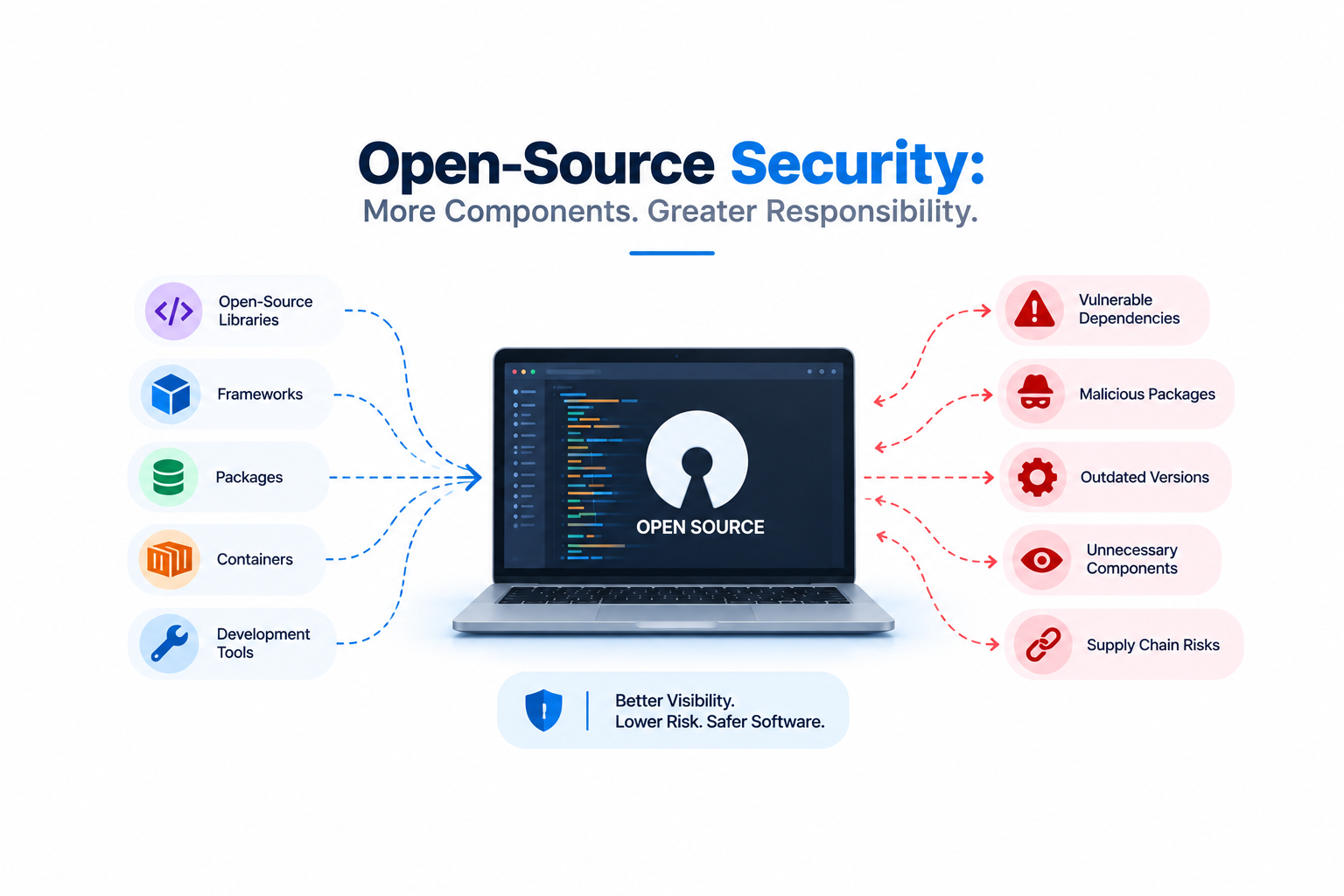
A modern application may contain thousands of software components that the development team did not write themselves. Open-source libraries, frameworks, packages, containers, and development tools help teams build and release software faster, but they also introduce dependencies that security teams need to understand and manage.
The challenge is not simply finding vulnerable packages. It is knowing what is being used, where it is used, whether the risk is exploitable, and how quickly it needs attention.
Why Open-Source Dependencies Create Security Risk
Open-source software is attractive because developers can reuse components rather than build common functionality from scratch. A library can handle authentication, logging, data processing, networking, or other application functions without requiring an internal team to develop everything independently.
The security problem begins when those dependencies become difficult to track.
A package may be included indirectly through another dependency. An application may continue using an outdated version long after a newer release becomes available. Development and production environments may also contain different sets of dependencies.
A vulnerability in one component therefore does not automatically mean every application using it has the same level of exposure.
Security teams need to understand the broader software supply chain including the code, dependencies, build systems, repositories, and deployment processes involved in delivering an application.
Visibility Comes Before Risk Management
You cannot manage a dependency that you do not know exists.
A useful starting point is maintaining an accurate inventory of open-source components across applications and environments. This should include direct dependencies as well as transitive dependencies introduced by other packages.
An inventory should help answer practical questions:
- Which applications use this component?
- Which version is deployed?
- Is it present in production?
- Who owns the application?
- What data or functionality could the component access?
- Is the dependency still required?
- Is a safer version available?
An SBOM can make this information easier to organize and communicate. It provides a structured view of the software components contained within an application and can support vulnerability investigation and dependency management.
For a deeper look at this approach, see software component inventory.
A Vulnerable Package Does Not Always Mean an Exploitable Application
One of the common mistakes in open-source security is treating every dependency vulnerability as equally urgent.
Consider an application that contains a vulnerable library. The vulnerability may exist in the installed version, but the affected functionality might never be used by the application. In another application, the same component could sit directly in a request-handling workflow exposed to the internet.
The technical vulnerability is similar. The practical risk is not.
Security teams should therefore consider factors such as:
- Where the component is deployed
- Whether the vulnerable function is actually used
- Whether the application is externally accessible
- What privileges the application has
- What data it can reach
- Whether a compensating control exists
- How difficult remediation would be
This creates a more useful distinction between a vulnerable dependency and an exposed dependency.
Security Has to Follow the Development Lifecycle
Open-source security cannot be treated as a final check immediately before production.
Dependencies enter applications during development, change during maintenance, and can be introduced through automated build processes. Security controls therefore need to operate throughout the software lifecycle.
Development teams can use dependency scanning, code review, approved package sources, and automated checks to identify problems earlier. Build pipelines can also enforce policies around prohibited or outdated components before software reaches production.
This connects closely with CI/CD pipeline security, where security controls are integrated into the processes used to build and deploy applications.
The goal is not to block developers every time a package has a security issue. Excessive blocking can encourage teams to bypass controls. Policies should distinguish between risks that require immediate action and those that can be investigated or remediated through normal development workflows.
What Security Teams Should Do
A practical open-source security program should focus on a few fundamentals:
- Maintain dependency visibility: Know which open-source components are used and where.
- Track ownership: Every important application and dependency should have someone responsible for remediation.
- Prioritize risk: Consider exploitability, exposure, application context, and business impact rather than vulnerability severity alone.
- Automate detection: Integrate dependency checks into development and CI/CD workflows.
- Control dependency sources: Use trusted repositories and establish policies for introducing new packages.
- Remove unnecessary dependencies: Components that are no longer needed create avoidable maintenance and security overhead.
- Prepare for urgent disclosures: Have a process for identifying affected applications, locating vulnerable versions, and coordinating remediation.
- Monitor continuously: A dependency that was acceptable yesterday may become a security concern after a new vulnerability is discovered.
Open-Source Security Is a Visibility Problem as Much as a Vulnerability Problem
Open-source software will remain a fundamental part of application development. Trying to eliminate every dependency is neither practical nor desirable.
The stronger approach is to understand what enters the software supply chain, where those components are used, and what happens when one of them becomes vulnerable. With accurate dependency visibility, contextual risk assessment, and security controls built into development workflows, organizations can benefit from open-source software without losing control of the risks it introduces.
About the Author
Nilesh Tank
Nilesh Tank is a VAPT Lead focused on penetration testing, vulnerability management, attack simulation, and offensive security. His expertise spans identifying security weaknesses and improving organizational security posture through proactive testing.
Is your Cyber Security 2026-Ready?
Stop ransomware and mitigate risks before they happen. Get a free architecture audit from our frontline security analysts.
Schedule a Strategy Call